
Full Circle
A political ecology reflection essay, written for a course on drivers of environmental injustice: companies, social metabolism, and (green) colonialism

Essay submitted on January 9, 2026 for a master’s program coordinated by Research & Degrowth International and ICTA-UAB
Part 1: The Work
Over the years, my work continues to feel like a band-aid to bigger and bigger societal problems.
I first got into the environmental space passionate about food waste. I would load up the back of my car with leftover food from our university cafeteria in Virginia, and deliver it to a local soup kitchen to feed people who needed to eat. After graduating, I worked for a year to help set up similar initiatives across the country, redistributing food that would have otherwise gone to waste.
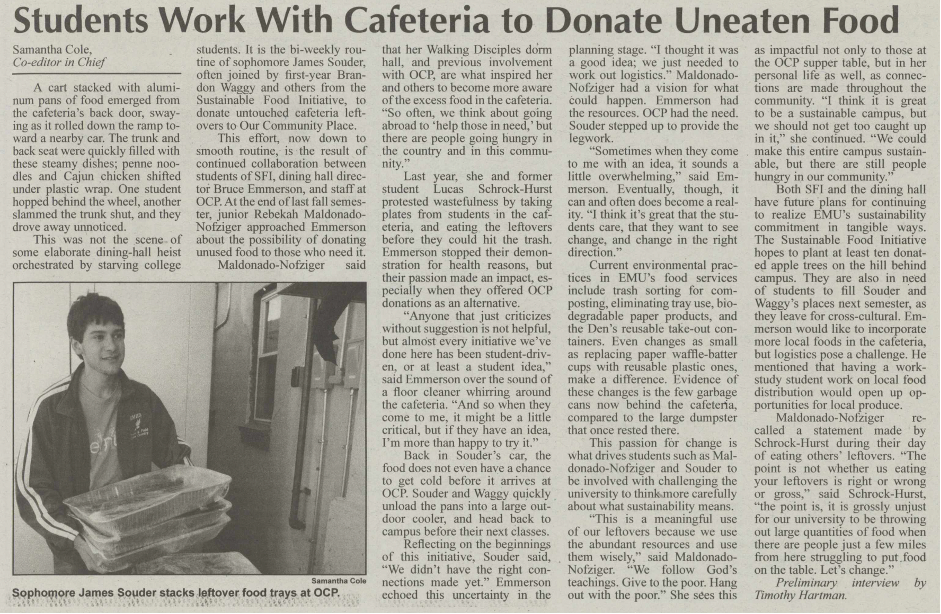
And then I asked myself, why is so much food being wasted in the first place? Was it a logistics problem? A production problem? I wanted to know more.
This question led me to graduate school, where I studied waste and production systems more broadly. I started my master’s degree in Industrial Ecology eager to understand how we’ve designed systems that allow so much food to be wasted, while so many people are hungry. The food waste door opened my eyes to production systems more broadly. I was introduced to the concept of industrial symbiosis, where the waste from one production system could be used as an input for another industry. The circular economy became a holy grail – companies could design systems that allowed materials in products to be used for as long as possible over multiple lifetimes. And materials that were reused or recycled would reduce the environmental impact of producing that product in the first place. I found my new direction.
After graduating, I moved to Amsterdam to work for a systems change organization as a consultant for companies, helping organizations come up with circular economy strategies. I worked primarily for electronics and consumer goods companies. After a few years of this work, I became worn down. Despite all our good efforts, any truly innovative idea would be shut down in the boardroom to prioritize quarterly profits. It really was all about money – if a sustainability initiative didn’t align with adding shareholder value, then it wouldn’t be seriously considered. More and more, I began to feel that my work was actually enabling corporate social irresponsibility (CSIR, as described by Bontemi, 2023), as circular economy initiatives essentially gave companies the social license to operate without making meaningful changes in current exploitative supply chain operations. I was working within a technical framework for analyzing circular value chains, but the environmental justice lens was missing. I became tired of talking about recirculating materials in a system that allows genocide to happen. The ongoing genocide in Gaza/Palestine is an environmental justice issue. So is the exploitation happening in Congo for minerals being used in our phones, being mined by children who are digging with their bare hands in collapsing mines.
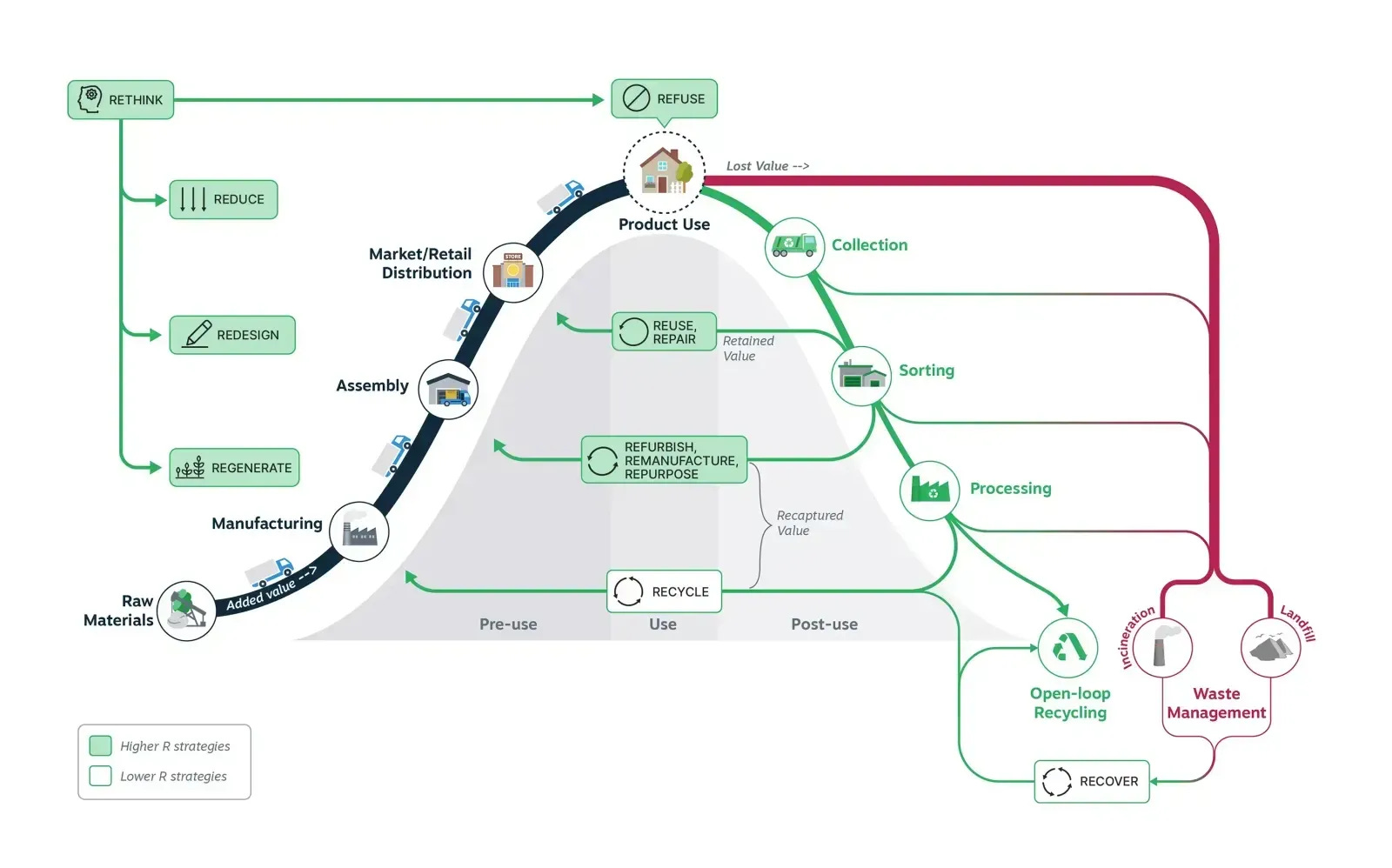
I attended a panel discussion back at my graduate school at Yale School of the Environment, where someone asked why we need to buy a new phone every year. And none of the panelists could give a good response. I realized that my work in the circular economy felt like a band-aid solution to an even bigger problem. Why are we so laser-focused on waste, or how much environmental impact one form of production has over the other, when the real question should be: Why are we producing so much stuff in the first place? And the deeper question: Why are we buying so much stuff? What emptiness are we trying to fill with material goods?
After the panel talk, I went up to one of the speakers to pry into this question further. He told me something along the lines of: “I can’t question growth; if I do, I’ll be ridiculed and my funding will get cut. But if you want to explore this further, look into the work of Jason Hickel at the University of Barcelona. They’re able to do that research there.”
So that brought me to my second master’s in Barcelona. Three months into this master’s program in Degrowth, Environmental Justice, and Political Ecology, and I’ve been able to grapple with concepts that feel like the core issues that need to be discussed, which have been tiptoed around in other spaces. Unequal exchange between the global north and the global south. Degrowth of unnecessary or harmful industries, and delinking historically repressed countries to use their own resources for their own benefit. The economy of genocide, and how wars are started and political movements are squashed for the pursuit of oil and control of resources. How capitalism keeps workers locked into systems of debt. How bodies are viewed as just another cog in the ever-churning growth machine. How endless growth on a finite planet is the same logic as a cancer cell.
And then we get to the solutions. Redirecting funds from unnecessary sectors towards actually meeting the needs of people. Cooperative-owned systems that own the means of production. Shorter working weeks where people are no longer reduced to producers and consumers but simply human beings who have agency over how and where they spend their time, energy, and resources. Meeting the needs of people without exceeding planetary boundaries.
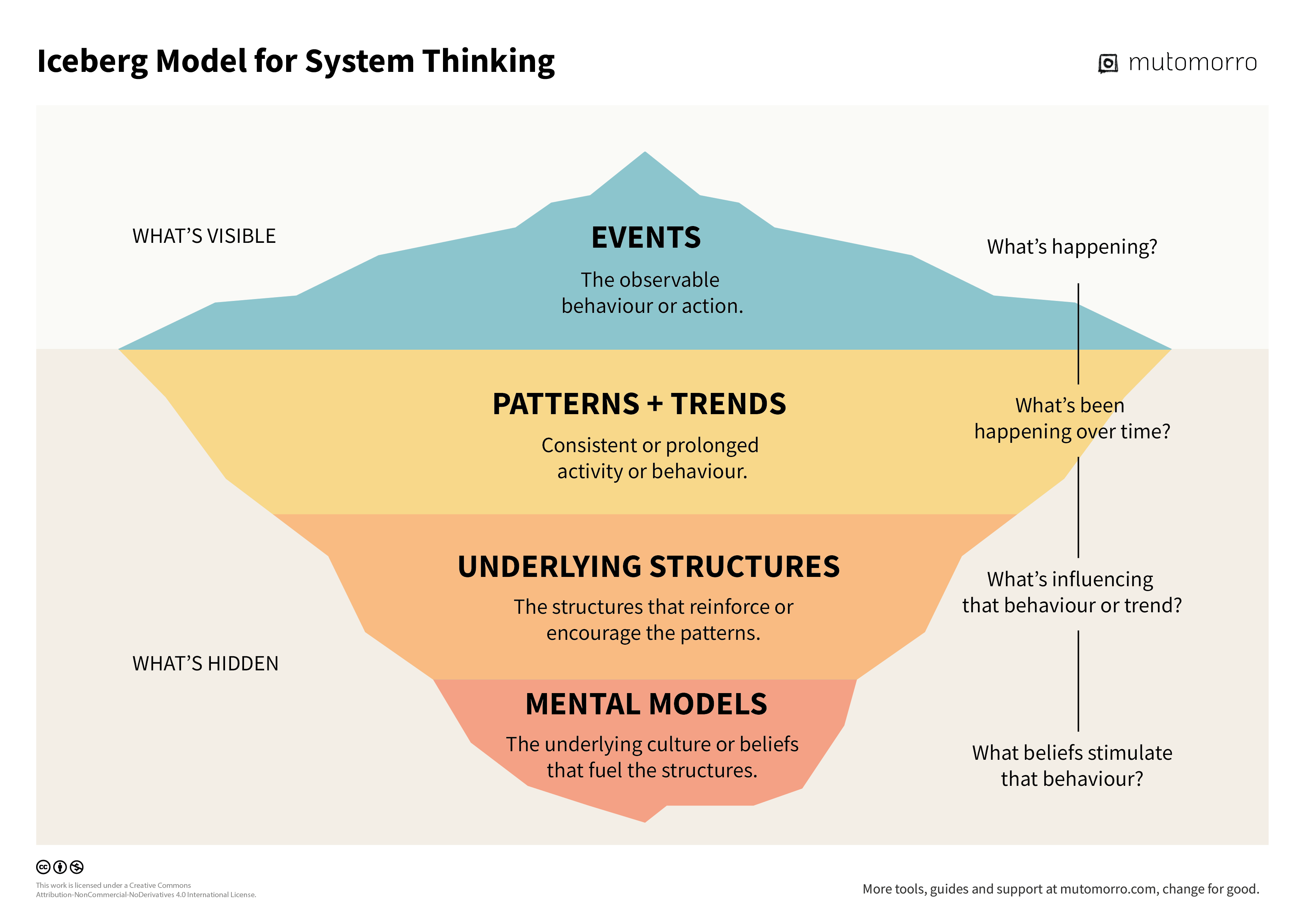
And of course, meeting the needs of people through localized networks of care and support. This reminds me a bit of what I was doing at the beginning of my environmental career, feeding people with food that otherwise would have been thrown away. But instead of feeling like I’m going against the current system, why not just design a system that works like this by default? And what does it take to make real system change? According to systems thinking frameworks, the most difficult changes to make are mental models that sit at the base of the iceberg model, with patterns, behaviors, and events closer to the tip. And to reach these deeper spaces, we need a real cultural and spiritual transformation – plus, I would add, trauma therapy.
Part 2: The Person
I had a burnout working as a consultant for companies on their circular economy strategies. On the surface level, I would tell you that the burnout came primarily from feeling like I wasn’t making an impact, that I was putting in all this energy into a system that didn’t inherently want to change. But this was simply one stressor among many.
Burnout has been described to me as feeling like you’re lying on a table with all your limbs being pulled in different directions. If any one life stressor pulls too hard, then your body will break.

My consulting lifestyle was certainly one stressor, and I was definitely putting too much pressure on myself to “change the world” on my own. I put the weight of solving the world’s issues on my shoulders. But in addition to that, my brain was wired to take on more and more responsibility beyond my body’s ability to function properly. I struggled with people-pleasing tendencies and lacked the ability to set personal boundaries. This stemmed from deeper-seated personal traumas of growing up as a closeted queer in the United States within the Mennonite church. My grandpa was a Mennonite pastor, which led to family norms of stifling difficult emotions and withholding self-expression to maintain the status quo and not “rock the boat” in order to live a life of peace and harmony in community. In this context, if you don’t fit within a specific mold of proper ways to behave or act, then it can be difficult to feel a sense of belonging in this space – with your true colors shining through.
As part of my burnout recovery, I received EMDR therapy (eye movement desensitization and reprocessing therapy) that worked through core traumatic memories and reprogrammed my patterns so that I was able to respond rather than react to similar stimuli. This has now allowed me to go through life and act in ways that are more closely aligned with my actual needs, desires, and values, rather than fitting into prescribed societal norms designed to control, contain, and silence.
The only way I was able to tackle these deeper layers of generational trauma was because I was given the headspace and time to work through it. I am incredibly lucky to have gone through my burnout in the Netherlands, one of the few countries in the world that treats burnout as a stress-induced illness. For the majority of people, particularly in the US, society and work are designed to keep people from being able to think and feel critically about the systems and structures that keep them locked into one way of doing things (namely, in ways continuing to operate within an ever-expanding war-fueled imperialist growth machine). And as we’ve learned in our degrowth and political ecology courses, this is done by design.
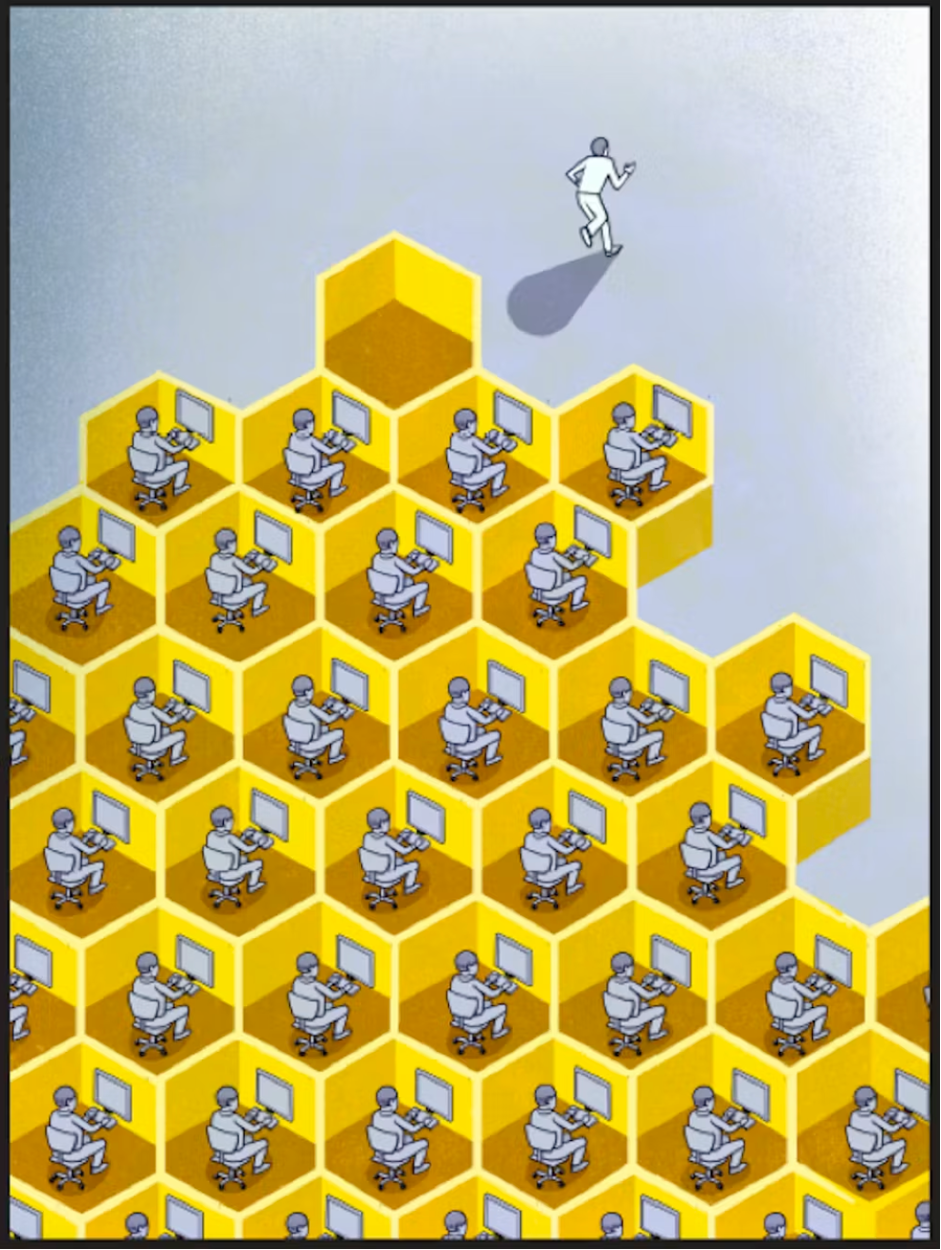
We live in a world that regulates human bodies for reproduction and maximizes economic output, that educates not for critical thinking but obedience, that divides gender into two binary buckets that allow for patriarchy to exploit the hidden costs of care work. The system is working exactly as it is intended, and we are feeling the societal effects of late-stage capitalism now: extreme weather events, biodiversity loss, wars over cheap resources, climate refugees – the list goes on.
I spent part of my winter break holiday back in my family home in Virginia. I am grateful in many ways for the life they have given me. There are also many things I wish had been done differently. But they were only able to provide me with the tools and emotional capacity they were taught by their own parents, and lessons they learned along the way.
As an end-of-year highlight, I posted a video of me performing a burlesque version of a song for a friend’s birthday from this summer – “Maybe This Time” from Cabaret. In this performance, I start in a leather outfit, complete with a long skirt and heels. By the end of the song I’ve stripped down, revealing my nearly-bare ass. As I’m stripping off layers of clothing, my singing becomes more guttural, digging deeper into emotional layers of anger, guilt, rage, and desperation. I practically spit out the lines “‘Lady Peaceful’, ‘Lady Happy’, that’s what I long to be.” I end with a cheeky glint in my eye: “Maybe this time I’ll win.”
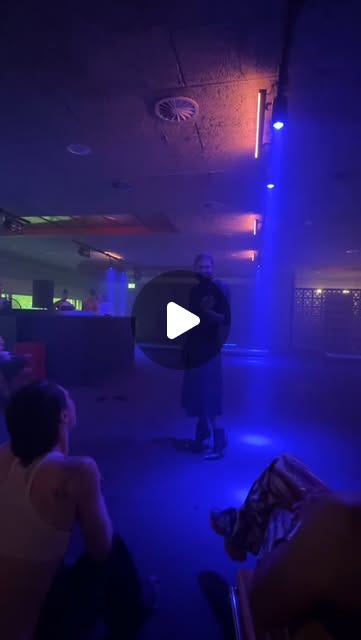
My parents were not pleased with me posting this video for the world to see. From their perspective, posting something this exposing online comes out of the blue, and it goes directly at odds with their view of my professional aspirations. They’re essentially telling me: “If I want to be taken seriously in this world (aka their world), I should seriously reconsider posting this video.”
But what they don’t see is the effect that making and posting this video has on me and the potential ripple effect for people like me. Growing up, my core traumas were centered around not being able to use my voice or express myself in ways that aligned with my identity or values. By performing and posting this video, I am shedding another layer of conditioning telling me how and what to do or say aligned with religious or sexually repressive expectations. And perhaps by posting this, I can be an example for another person to see that it is possible to show a fuller part of themselves, in ways that disrupt patriarchy and heteronormativity.
While this personal ability to express myself and feel into deeper emotions may at first seem disconnected from degrowth work, I am reminded of this quote from environmental sociologist Gus Speth, who is quoted at the front of the book No Bad Parts by Richard Schwartz (one of my self-healing guides):
“I used to think that top environmental problems were biodiversity loss, ecosystem collapse, and climate change. I thought thirty years of good science could address these problems. I was wrong. The top environmental problems are selfishness, greed, and apathy, and to deal with these we need a cultural and spiritual transformation. And we scientists [and lawyers] don’t know how to do that.”
I spent a fair amount of time in therapy to arrive at the conclusion that “I am enough.” This inherent sense of lack is deeply ingrained within our human psyche, in ways that corporate powers use to their advantage to sell us more stuff. As outlined in the book The Velvet Rage, consumerism – particularly around gay male norms – is often used as a mask for the lack of validation we feel inside. We look externally for approval in ways that weren’t provided by our parents growing up. The task we face in order to remove ourselves from this consumerism-driven rat-race is to be enough just as we are.
As part of my burnout recovery process, I began working as a massage therapist. This process allowed me to get out of my head and into my body, using physical touch as a meditative practice. I became more present, more in touch with my body and what it requires to sustain life. In this way, I began embodying the therapy I went through myself, slowing down enough to provide from a place of rest rather than continuous exhaustion. And now I seek a balance: Enough time in my mind aligned with time spent in my body.

Part 3: The Body
As I am writing this essay, three of the UK Palestine Action hunger strikers are at imminent risk of having their body systems shut down, resulting in immediate death. They are using their bodies as a final form of protest against an unjust system that puts profit ahead of people. They are protesting being held without trial for over 14 months, imprisoned for causing material damage to drones and warplanes that are used to kill civilians in Gaza.
While these protestors starve themselves for more than 60 days, I am reminded of the work I did at the beginning of my environmental journey – feeding people with food that was going to be wasted. This work also uncovers a deeper societal issue: Why are people going hungry in the first place?
And also: A hunger for what? For food, of course. But also hungry for a world system that doesn’t exploit or bomb innocent people for land and resources. Hungry for a system that feeds nourishing foods, rather than making weapons used to kill people.
I want to direct my money, time, and resources towards feeding a system that nourishes rather than starves the land of its ability to feed me. As Robin Kimmerer notes in Braiding Sweetgrass, “Refusal to participate is a moral choice.” We can stop this trajectory with collective action. Boycott it. Starve it of its ability to reproduce. Stop the economy of genocide.
But how do we get there? According to Bontemi (2023), “dominant narratives produced by those in power need to be confronted with alternative narratives built in decentralized ways outside of centers of power.” How do we get there in practice? By building networks of community support in times of societal collapse. By creating new imaginaries and envisioning new utopias, for example, as outlined by Larry Mitchell in The Faggots and Their Friends Between Revolutions: “The strong women told the faggots that there are two important things to remember about the coming revolutions. The first is that we will get our asses kicked. The second is that we will win.” We need communities that prioritize the well-being of their most vulnerable people — whether refugees, migrants, Indigenous folks, queers, or trans people of color — people who are now most affected by environmental justice concerns.
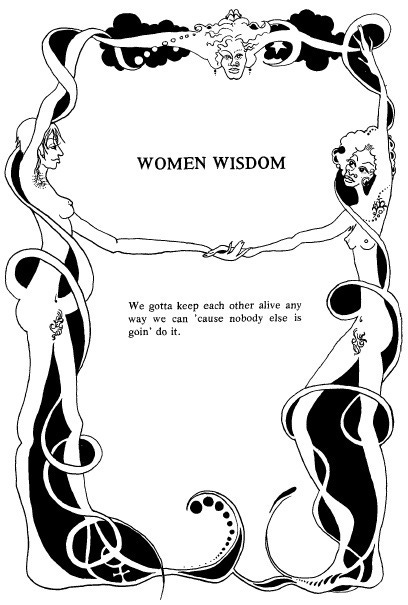
As discussed in our political ecology class, if you want to understand a system of oppression, ask the oppressed. New systems cannot be built in a vacuum without direct involvement by the people who are most affected by the harms caused by our current system. And as outlined by Audre Lorde, ‘the master’s tools will never dismantle the master’s house.’ The exploitative, fossil-fuel-driven system we live within cannot be reformed, nor can we rely on it to transform itself fast enough to fit within ecological boundaries. The amount of money fossil fuel companies contribute to renewable energy technology investments could be written off as a rounding error, despite the outsized ‘greening’ campaign touted by these companies (Llavero-Pasquina, 2024). An entirely new system needs to be built outside of current systems of power and control, as current systems will merely replicate existing colonial power structures.
A new world needs to be embodied, built through intentional action from a clear vision that prioritizes collective well-being over individual wealth. Just as my environmental journey began with physically delivering surplus food to local soup kitchens, building the new world will require embodying our ideals through direct political action. Growing food for neighbors, developing networks of care, creating alternative ways of existing between the ever-growing cracks of Empire. My journey has come full circle, as I am now exploring how it feels to carry the weight of building a new world, this time collectively rather than on my own.
References
Bontempi, A., Del Bene, D., & Di Felice, L. J. (2023). Counter-reporting sustainability from the bottom up: the case of the construction company WeBuild and dam-related conflicts. Journal of Business Ethics, 182(1), 7-32. https://doi.org/10.1007/s10551-021-04946-6
Downs, A. (2005). The Velvet Rage: Overcoming the Pain of Growing Up Gay in a Straight Man’s World. Da Capo Press.
Kimmerer, R. W. (2015). Braiding sweetgrass. Milkweed Editions.
Llavero-Pasquina, M., Navas, G., Cantoni, R., & Martínez-Alier, J. (2024). The political ecology of oil and gas corporations: TotalEnergies and post-colonial exploitation to concentrate energy in industrial economies. Energy Research & Social Science, 109, 103434. https://doi.org/10.1016/j.erss.2024.103434
Mitchell, L. & Asta, N. (1977). The faggots and their friends between revolutions. Calamus Books.
Schwartz, R. C. (2021). No bad parts: Healing trauma & restoring wholeness with the internal family systems model. Sounds True.
Resonate with so much of this! Thanks for sharing James. x